




Introduction
A good work routine should make your day easier, not turn every hour into another task to manage. Yet many people start their mornings without a clear plan, move between tasks constantly, and finish the day wondering where their time went.
The goal of a work routine isn’t to schedule every minute. It is to create a simple structure that helps you understand what needs your attention, when you work best, and which habits make your day smoother.
Whether you work from home, in an office, study alongside other responsibilities, or manage your own projects, a practical routine can help you work with more intention. This guide explains how to create a flexible routine that fits your actual working style rather than an unrealistic ideal.
What Is a Work Routine?
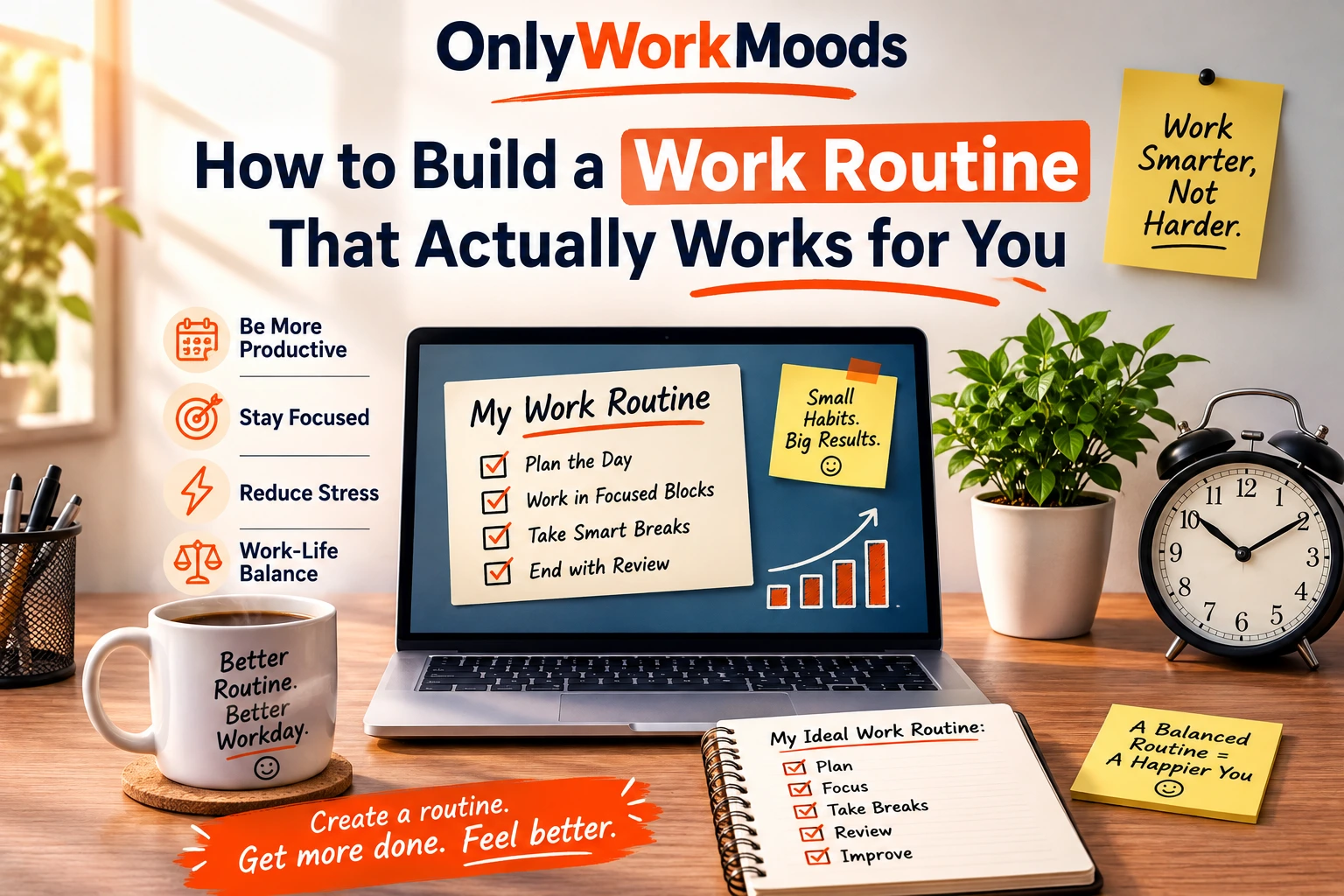
A work routine is a repeatable structure for organizing your working day. It can include when you begin work, how you prioritize tasks, when you take breaks, how you handle communication, and how you finish your day.
A routine does not have to be complicated.
For example, a simple routine might look like:
- Review priorities in the morning.
- Start with the most important task.
- Check messages at planned times.
- Take short breaks between periods of focused work.
- Review unfinished tasks before ending the day.
- Decide what needs attention tomorrow.
The exact structure can change depending on your job and responsibilities.
Why a Simple Work Routine Can Help
Without a basic structure, your day can easily become reactive. A new email arrives, then a message, then an unexpected request, and suddenly the task you originally planned to complete has been pushed aside.
A practical routine creates a starting point.
It can help you:
- Understand your priorities
- Reduce unnecessary switching between tasks
- Protect time for focused work
- Keep smaller responsibilities from being forgotten
- Create a clearer end to the working day
- Make planning less complicated
The key is to create enough structure to provide direction without making your day rigid.
Start by Identifying Your Most Important Work
One of the easiest ways to improve a work routine is to separate important work from everything that simply appears during the day.
At the beginning of your workday, ask:
“What would make today feel worthwhile if I completed it?”
Choose one to three meaningful priorities.
These could be:
- Completing an important report
- Preparing a presentation
- Writing an article
- Finishing a client task
- Studying a difficult topic
- Planning an upcoming project
This doesn’t mean other tasks are unimportant. It simply prevents your priority list from becoming a collection of twenty equally urgent items.
Try the “Must, Should, Could” Method
Divide tasks into three groups:
| Priority | Meaning | Example |
|---|---|---|
| Must | Needs attention today | Submit a required report |
| Should | Important but flexible | Organize project notes |
| Could | Useful if time allows | Clean up old files |
This simple approach makes your workload easier to view.
Build Your Routine Around Energy, Not Just Time
Everyone has periods when concentrating feels easier and periods when mental energy drops.
Instead of automatically assigning every task to a fixed time, consider your natural working pattern.
For example:
Higher-energy period
- Writing
- Planning
- Problem-solving
- Learning
- Creative work
Lower-energy period
- File organization
- Scheduling
- Routine administration
- Simple follow-ups
You don’t have to follow this pattern perfectly. The idea is simply to avoid spending your best concentration on tasks that require very little thinking.
Protect Time for Focused Work
Constant interruptions can make even straightforward work feel difficult.
If your work requires concentration, create periods when you can focus without repeatedly checking notifications.
During focused work, consider:
- Closing unnecessary browser tabs
- Muting non-essential notifications
- Keeping your phone away when practical
- Working from a quieter location
- Using a simple task list
- Avoiding unnecessary meetings
You don’t necessarily need hours of uninterrupted time. Even a clearly protected period can make a difference to how you approach demanding work.
Don’t Build a Routine Around Multitasking
Multitasking can feel productive because you appear to be handling several things at once. In practice, constantly moving between unrelated tasks can make your workflow feel fragmented.
Instead of:
Email → spreadsheet → message → presentation → email → social media
Try grouping similar activities.
For example:
Focus block
Work on one important project.
Communication block
Respond to messages and email.
Administrative block
Handle routine tasks and organization.
Review block
Check progress and prepare for the next work period.
Grouping similar activities can make your day feel less scattered.
Create a Better Morning Start
Your first few minutes can influence how organized the rest of your day feels.
You don’t need an elaborate morning ritual. A simple five-step start can be enough:
- Check your schedule.
- Review unfinished work.
- Choose your main priority.
- Remove obvious distractions.
- Begin rather than continuing to plan.
The last step matters.
Planning can become another form of procrastination if you spend more time designing the perfect routine than actually using it.
Give Breaks a Real Place in Your Routine
Breaks aren’t simply empty spaces between tasks. They can give you an opportunity to step away from the screen, move around, get water, or reset your attention.
A useful break doesn’t have to involve another digital activity.
Try:
- Walking for a few minutes
- Stretching
- Getting a drink
- Looking away from your screen
- Sitting somewhere different
- Having a brief conversation
The purpose isn’t to create another productivity challenge. It is simply to avoid treating continuous work as the only acceptable way to spend a workday.
Make Meetings Work Around Your Routine
Meetings can easily divide a workday into small pieces.
When possible, group meetings together or place them around periods when you don’t need long stretches of concentration.
Before accepting or scheduling a meeting, consider:
- Is the meeting necessary?
- Do I need to attend?
- Could the information be shared another way?
- Does the meeting interrupt important focused work?
- Can several related discussions be combined?
Not every workplace gives you control over meetings, but even small adjustments can help protect useful working time.
Create an End-of-Day Routine
A work routine shouldn’t only tell you how to start. It should also help you finish.
A short shutdown routine might take just a few minutes.
Before ending work:
- Mark completed tasks.
- Move unfinished tasks to your list.
- Identify tomorrow’s main priority.
- Check for genuinely urgent messages.
- Close unnecessary work tabs.
- Tidy your workspace if useful.
This gives your brain a clear stopping point.
It also means you don’t have to spend the first part of tomorrow figuring out what you were doing today.
Your Work Routine Should Be Flexible
One of the biggest mistakes people make is creating a routine that works only on a perfect day.
Real workdays include:
- Unexpected requests
- Meetings
- Technical problems
- Changing deadlines
- Personal responsibilities
- New priorities
Your routine needs space for those things.
Think of your schedule as a framework rather than a prison.
If something unexpected happens, adjust the plan instead of treating the entire day as a failure.
Example of a Practical Work Routine
Here’s an example of how a balanced workday might be structured:
| Part of Day | Main Activity |
|---|---|
| Start of day | Review priorities |
| Early work period | Most important focused task |
| Mid-morning | Communication and smaller tasks |
| Midday | Break and reset |
| Afternoon | Project work and meetings |
| Later afternoon | Administrative tasks |
| End of day | Review and tomorrow’s priorities |
This is only an example. Your ideal routine should reflect your working hours, responsibilities, energy levels, and workplace expectations.
Common Work Routine Mistakes
1. Planning too much
A list with thirty tasks may look organized, but it can quickly become overwhelming.
Better approach: Choose a small number of meaningful priorities.
2. Checking messages constantly
Frequent notifications can pull attention away from important work.
Better approach: Check communication at reasonable points throughout the day when your role allows it.
3. Making every minute productive
A routine that leaves no room for breaks or unexpected work is difficult to maintain.
Better approach: Leave some flexibility in your schedule.
4. Copying someone else’s routine
A routine that works for another person may not match your responsibilities.
Better approach: Borrow useful ideas, then adapt them.
5. Changing the routine every day
Constantly redesigning your system can create more work.
Better approach: Keep a simple structure for a while and adjust only when something consistently isn’t working.
How to Improve Your Work Routine Over Time
You don’t need to create the perfect routine on day one.
Instead, treat it as something you can gradually improve.
At the end of each week, ask yourself:
- What part of my routine worked well?
- What repeatedly interrupted my work?
- Which tasks took longer than expected?
- When did I feel most focused?
- What could I simplify?
- What should I stop doing?
Choose one or two changes to test.
Small adjustments are often easier to maintain than completely rebuilding your schedule.
A Simple Work Routine Checklist
Use this checklist when creating your own routine:
- I know my main priority for the day.
- My important work has protected focus time.
- I have a reasonable way to handle messages.
- My routine includes breaks.
- I leave room for unexpected tasks.
- I don’t overload my daily task list.
- I have a clear end-of-day process.
- I review what is and isn’t working.
- My routine fits my actual responsibilities.
- I can adjust the routine when circumstances change.
Frequently Asked Questions
What is a good work routine?
A good work routine is a repeatable structure that helps you prioritize important tasks, manage communication, take breaks, and finish your workday clearly. It should provide direction without making your schedule unnecessarily rigid.
How do I create a work routine?
Start by identifying your most important daily responsibilities, then assign time for focused work, communication, breaks, and routine tasks. Keep the system simple and adjust it based on what actually works for you.
How many tasks should I plan for a workday?
There is no universal number that works for everyone because workloads vary significantly. A better approach is to identify a small number of meaningful priorities and treat additional tasks as secondary when possible.
Should I check email throughout the day?
It depends on your job and how quickly you need to respond. If immediate responses aren’t required, grouping email and message checks into reasonable periods can help reduce unnecessary interruptions.
Can a work routine reduce stress?
A structured routine may make work feel more manageable by clarifying priorities and reducing unnecessary decision-making. However, a routine cannot remove workload, deadlines, or workplace problems on its own.
Should my work routine be the same every day?
Not necessarily. A consistent basic structure can be useful, but your routine should have enough flexibility to accommodate meetings, deadlines, unexpected requests, and different types of work.
Final Thoughts
A useful work routine doesn’t need to be impressive. It needs to be practical.
Start with a few simple habits: identify your priorities, protect time for focused work, group similar tasks, take genuine breaks, and create a short end-of-day process.
Then pay attention to what happens in real life.
If something consistently makes your day harder, change it. If something makes your work smoother, keep it.
The best routine is not the one that looks perfect on paper. It’s the one you can realistically follow and improve over time.
For more practical ideas about creating better work habits and a healthier approach to everyday productivity, keep exploring OnlyWorkMoods.